Paystub Basics
Commission Earnings on a Paystub: What to Review
Tiered rates, draws, splits and chargebacks all change the commission line. Here is how to trace it to the plan, the sales report and the YTD totals.
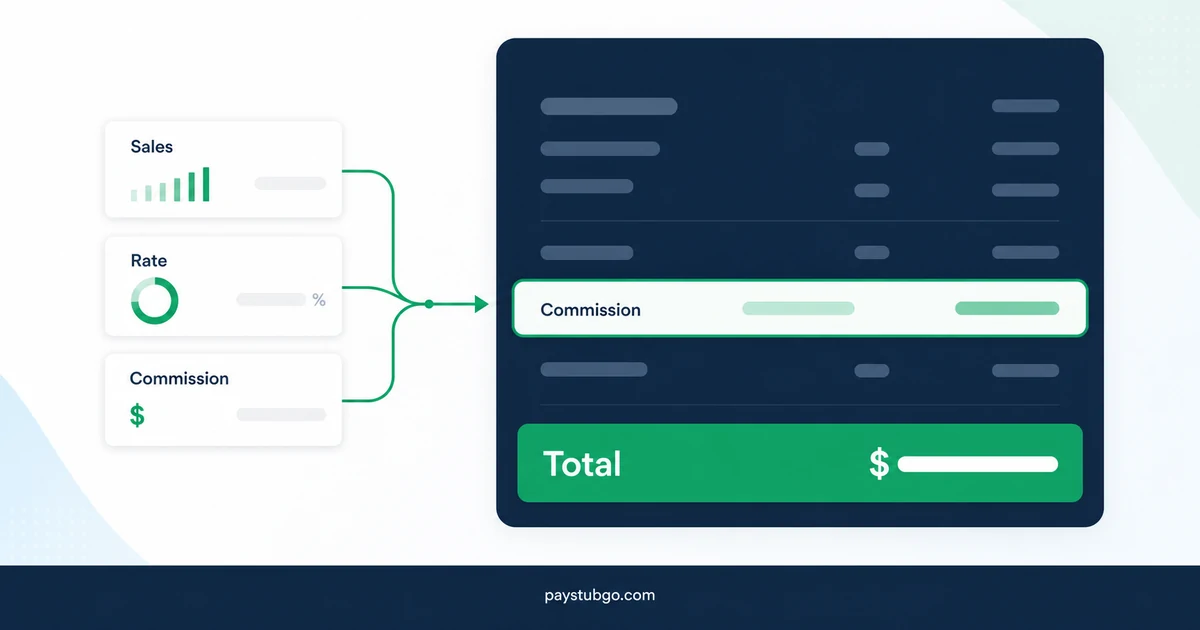
Table of Contents
What this guide covers
12 sectionsHide
Table of Contents
What this guide covers
Scroll inside this box to view all guide topics.
- The commission line and the documents behind it
- Commission structures and how each shows up
- A tiered monthly commission
- A recoverable draw across two months
- When commissions are earned versus paid
- Commissions and overtime for non-exempt employees
- Withholding on commission pay
- Chargebacks, clawbacks and negative lines
- What to review on each commission stub
- State rules on commission plans and final pay
- Commission paid to independent contractors
- Recording commission on a paystub record
Commission earnings appear on a paystub as a separate line, often labeled COMM, showing money earned from sales rather than hours. To review it, match the amount to the commission statement, confirm which sales period it covers, check any draw or chargeback lines, and make sure it is included in gross pay and YTD.
Commission lines are harder to check than hourly pay because the calculation lives outside the stub, in a plan document and a sales report. The sections below cover the common commission structures, work two examples with made-up figures, and explain timing, overtime, withholding and chargebacks before ending with a review list. For the rest of the stub's layout, the guide to the sections of a pay stub is a good companion.
The commission line and the documents behind it
On the stub itself, a commission line usually shows a description and a current amount, and sometimes the sales base in the units column with the percentage in the rate column. It also carries a YTD figure that grows unevenly from one stub to the next.
Three documents sit behind that single number:
- The commission plan. It sets the rates, any tiers or thresholds, when a commission counts as earned, how draws work and when commission can be reversed.
- The commission statement. It lists the deals or sales credited in the period and the commission on each.
- The sales or order report. It confirms the sales on the statement actually closed, shipped or were paid for, depending on the plan's definition.
The stub is the last step in that chain. When the line looks wrong, the error is almost always in one of the three documents rather than in the payroll system.
Commission structures and how each shows up
| Structure | How it is calculated | What the stub may show |
|---|---|---|
| Straight commission | A percentage of sales only | A COMM line with no regular pay line |
| Base plus commission | Salary or hourly pay plus a percentage of sales | A REG line and a COMM line |
| Tiered commission | Higher percentages above set sales levels | One COMM line, or one line per tier |
| Draw against commission | An advance each period, settled against commission earned | A DRAW line, a COMM line, sometimes a recovery |
| Split commission | One sale's commission shared between sellers | A COMM line with a partial amount |
| Chargeback | Commission reversed after a canceled or returned sale | A negative COMM line or a deduction |
The structure determines what to check. A tiered plan needs the tier thresholds, a draw needs the running balance, and a split needs the agreed shares.
A tiered monthly commission
Illustrative example (made-up figures): a sales employee's plan pays 3% on monthly sales up to $30,000 and 5% on sales above $30,000. In March they close $48,000 in sales.
- First tier: 3% × $30,000.00 = $900.00
- Second tier: 5% × ($48,000.00 − $30,000.00) = 5% × $18,000.00 = $900.00
- March commission: $900.00 + $900.00 = $1,800.00
If the April stub shows $2,400.00 instead, the whole $48,000.00 was paid at 5%, since 5% × $48,000.00 = $2,400.00. Some plans do work that way, paying the higher rate on every sale once the threshold is reached, while others apply it only to the portion above. The plan document decides which, and it is the first thing to check when a tiered commission looks too high or too low.
A recoverable draw across two months
Illustrative example (made-up figures): a sales employee receives a recoverable draw of $1,500.00 a month. In month one they earn $1,100.00 in commission; in month two they earn $2,300.00.
| Month | Commission earned | Shortfall carried in | Paid on the stub |
|---|---|---|---|
| Month 1 | $1,100.00 | $0.00 | $1,500.00 draw |
| Month 2 | $2,300.00 | $400.00 | $1,500.00 draw + $400.00 commission |
In month one the employee earned $400.00 less than the draw, so the plan carries a $400.00 shortfall forward. In month two the commission earned, less the carried shortfall, is $2,300.00 − $400.00 = $1,900.00. That exceeds the draw, so the stub shows the $1,500.00 draw plus $400.00 of commission, and the shortfall is cleared.
Under a nonrecoverable draw, the month-one shortfall would simply be forgiven, and month two would pay the $1,500.00 draw plus $800.00 of commission, for the full $2,300.00. Which kind of draw applies is written in the plan, and state law affects whether an unpaid balance can be recovered when employment ends.
When commissions are earned versus paid
Commissions are often calculated after the sales period closes and paid on a later payday, so the pay period dates on the stub rarely match the sales dates. A stub for March 1 to March 15 might carry February's commissions, while March's arrive in April. The distinction between the dates on a stub is covered in pay date and period end date.
That lag matters at year end. Form W-2 reports wages paid during the calendar year, so commission on December sales that is paid in January counts toward the next year's YTD totals and W-2. When YTD commission on the last stub of the year looks low, check whether December's commission is still to come.
Commissions and overtime for non-exempt employees
For employees who are entitled to overtime, commissions raise the rate that overtime is paid on. Department of Labor Fact Sheet #23 (revised October 2019) includes commissions in the regular rate. Take a week of 42 hours at $16.00 an hour with $168.00 of commission earned in that week: straight-time pay plus commission is $672.00 + $168.00 = $840.00, the regular rate is $840.00 ÷ 42 = $20.00, and the premium for 2 overtime hours is 2 × $10.00 = $20.00.
Commissions paid for longer periods make this more involved, because they have to be connected back to the workweeks they relate to, and payroll handles that step. Some commissioned employees in retail or service businesses may fall under a specific FLSA overtime exemption, which payroll or the Department of Labor's guidance can confirm.
Withholding on commission pay
IRS Publication 15 (2026) treats commissions as supplemental wages, the same category as bonuses. When the commission is identified separately from regular wages and income tax was withheld from regular wages in the current or preceding calendar year, the employer may withhold a flat 22%. Otherwise, or by choice, it can combine the commission with regular wages and withhold on the total. Supplemental wages above $1 million in a year face a mandatory 37%.
When commission is paid together with regular pay and the amounts are not specified separately, Publication 15 has the employer withhold on the combined total as a single payment. Social Security and Medicare apply at their usual rates either way. A worked comparison of the two withholding methods is in bonus and supplemental withholding.
Chargebacks, clawbacks and negative lines
A chargeback reverses commission already paid on a sale that was canceled, returned or never collected. It can appear in two ways, and they do not have the same effect:
- A negative commission line in the earnings section lowers gross pay for the period, so taxable wages and the taxes figured on them fall too.
- A recovery deduction taken after tax leaves gross pay and taxes unchanged and lowers only net pay.
If a chargeback of $250.00 appears as a deduction when the plan describes it as an earnings adjustment, taxable wages are $250.00 higher than they would otherwise be. It is worth asking payroll which method was used, especially for large reversals.
What to review on each commission stub
- Match the commission amount to the commission statement for the stated period.
- Recalculate tiers or percentages against the plan, including whether higher rates apply to all sales or only the excess.
- Check that splits reflect the agreed shares.
- Confirm any draw line and the running shortfall or surplus.
- Identify chargebacks and whether they appear as negative earnings or as deductions.
- For non-exempt employees, confirm that overtime reflects the commission for the weeks it covers.
- Look at federal withholding to see which supplemental method was used.
- Add the commission to the YTD commission figure from the previous stub, as described in YTD figures on a paystub.
State rules on commission plans and final pay
State law adds several layers that federal rules do not cover. Some states require commission plans to be written and signed, some set deadlines for paying commission earned before an employee leaves, and many limit when an employer can recover unearned draws or chargebacks from wages, particularly from a final paycheck. These rules are enforced by state labor departments, whose websites are the place to check the requirements for a particular job.
Commission paid to independent contractors
A sales representative who works as an independent contractor receives commission without payroll withholding and without a paystub. The record is usually an invoice or a commission statement from the business, and the representative handles their own taxes. The differences between the two kinds of records are explained in contractor payment records.
Recording commission on a paystub record
PayStubGo's paystub generator has a single Commission field for each stub, and the amount entered there is added to gross pay alongside regular pay, overtime and any bonus. Enter the commission total from the statement for that pay date and keep the statement with the stub, since the form does not break the figure into tiers, splits or draws. If a chargeback or draw recovery affects the period, check that the preview's gross and net pay agree with the source payroll record.
The worked figures on this page are illustrations, not a reading of any real commission plan. How a specific plan, chargeback or final commission should be paid depends on its written terms and state law, so the employer's payroll department or an employment law professional is the right source, and PayStubGo simply formats the amounts you enter.
PayStubGo
Create a paystub from your own details
Preview your paystub, review the layout, and download a clean PDF when the information looks right.