Taxes and Deductions
Tips on a Pay Stub: Reported Tips and the Tip Credit
Understand how reported tips, the tip credit, and allocated tips are recorded on your pay stub, how they alter your taxes, and why your cash paycheck changes.
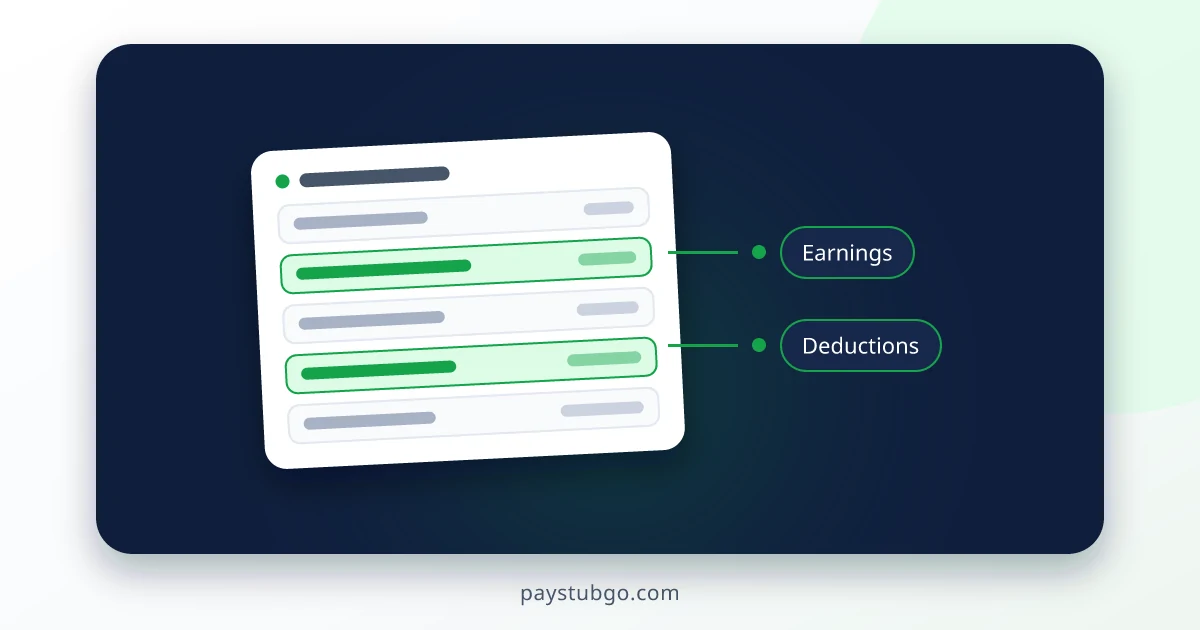
Table of Contents
What this guide covers
7 sectionsHide
Table of Contents
What this guide covers
Scroll inside this box to view all guide topics.
- How Tips on a Pay Stub Differ From Regular Earnings
- Baseline Paystub Calculation for Non-Tipped Staff
- Tracing Reported Tips and Withholding on Your Earnings Statement
- The Federal Tip Credit and Minimum Wage Rules
- How Overtime Is Calculated for Tipped Employees
- What Are Allocated Tips and Why Do They Appear?
- State-Specific Tip Laws and Payroll Variations
Tips on a pay stub represent additional income that tipped employees must report for tax withholding, separate from hourly cash wages. Because workers usually receive cash or credit card tips directly, these amounts increase taxable gross wages but are deducted before net pay is computed to avoid paying the same funds twice. This reporting ensures compliance with federal and state regulations, which governs how your overall compensation is taxed and displayed.
Understanding how tipped income flows through your check helps you verify that your employer is paying you correctly and that your withholding is accurate. Whether you are reviewing your weekly earnings or using an online paystub generator to draft professional records, tracing these lines is essential to keeping your personal files correct.
How Tips on a Pay Stub Differ From Regular Earnings
For most workers, compensation follows a direct line: you work a set number of hours at a designated rate, your employer calculates your gross earnings, subtracts tax withholdings, and pays you the remaining net balance. However, tipped employees receive their compensation through two distinct channels: direct payments from customers (tips) and hourly cash wages from their employer.
The Internal Revenue Service (IRS) classifies all tips as taxable income. Under federal guidelines outlined in IRS Publication 531, employees must report cash and credit card tips to their employers if the total exceeds $20 in any calendar month. When these tips are recorded, they change the relationship between gross versus net pay on your paycheck.
Because you usually pocket cash tips at the end of a shift, or receive card tips through daily tip-outs, you already possess this money before your paycheck is processed. If your employer simply added your tips to your hourly wages and handed you a check for the total, they would be paying you the same money a second time.
To correct for this, the payroll engine performs a three-step cycle on your paycheck statement:
- Addition: Your reported tips are added to your base hourly wages in the earnings section to establish your total gross taxable pay.
- Calculation: Your federal, state, and local taxes are calculated based on this total gross taxable pay.
- Subtraction: Your reported tips are subtracted in the deductions section (often labeled as "Tips Paid Out" or "Cash Tips Collected") so your final net pay only reflects the actual cash wages owed by your employer.
Baseline Paystub Calculation for Non-Tipped Staff
To contrast how tipped wages differ from standard hourly pay, let us first examine a standard paycheck. This baseline helps illustrate how regular pay flows directly into net pay when no tips are involved.
Illustrative example 1: a single filer in Arizona at $21.00 an hour for 80 regular hours, paid every two weeks, with no pre-tax deductions, one pay period computed with PayStubGo's paystub calculator for the 2026 tax year (an illustration, not tax advice).
| Example 1 line | Amount |
|---|---|
| Regular pay | $1,680.00 |
| Gross pay | $1,680.00 |
| Federal income tax withholding | $117.75 |
| Social Security | $104.16 |
| Medicare | $24.36 |
| Arizona state income tax | $33.60 |
| Net pay | $1,400.13 |
In this non-tipped scenario, the entire $1,680.00 gross pay is cash that the employer must pay to the employee. After the standard deductions for federal, state, and FICA tax deductions are withheld, the employee receives a single physical or electronic payment of $1,400.13.
For a tipped worker, however, if their total gross taxable pay is also $1,680.00, but $1,000.00 of that came from credit card and cash tips they already pocketed, the actual paycheck issued by the employer will be significantly smaller because that $1,000.00 has already been received.
Tracing Reported Tips and Withholding on Your Earnings Statement
When you read an earnings statement as a tipped employee, you will notice unique line items that correspond to different tip categories. Here is how these lines are typically designated and why they matter:
- Direct Tips / Reported Tips: This represents cash tips you declared to your employer or card tips processed through the business POS system. This line exists to increase your gross taxable wages so taxes can be computed on your full earnings.
- Base Cash Wages: This is the direct hourly rate paid to you by your employer. Depending on the state and the tip credit claimed, this rate may be lower than the standard minimum wage.
- Tips Paid Out / Cash Tip Deduction: This line is located in the deductions or tax section. It offsets the "Direct Tips" line in the earnings section. Because you already received the cash, this deduction ensures your employer does not double-pay those tips, while still keeping the tax withholdings on the check.
Because taxes are calculated on your base wages plus your reported tips, your tax withholdings can easily consume a large portion of your base hourly wages. If you earn high tips and have a low hourly cash wage, your entire cash wage might go toward covering federal, state, and local income taxes.
This dynamic frequently leads to "zero-dollar paychecks" in the service industry. When this occurs, your pay stub will show a gross pay matching your total earnings, but your net pay line will print as $0.00 because your hourly wages were entirely exhausted by your tax obligations. Any remaining unpaid tax liability from that pay period is typically carried forward or reconciled when you file your annual tax return.
The Federal Tip Credit and Minimum Wage Rules
Under the Fair Labor Standards Act (FLSA), the federal minimum wage is $7.25 per hour. However, section 3(m) of the FLSA permits employers of tipped employees to claim an FLSA tip credit. This rule allows employers to pay a direct cash wage of as little as $2.13 per hour, claiming a tip credit of up to $5.12 per hour against their minimum wage obligation.
The U.S. Department of Labor Wage and Hour Division monitors these regulations, which can be reviewed on their official site at https://www.dol.gov/agencies/whd. To claim the tip credit, an employer must verify that the employee regularly and customarily receives more than $30 a month in tips and that the combination of direct cash wages ($2.13/hr) and received tips equals at least the federal minimum wage of $7.25 per hour.
If your direct cash wages and tips do not equal the standard minimum wage during a given workweek, your employer is legally required to make up the difference. On your paycheck stub, this adjustment will usually appear as a separate earnings line labeled "Tip Makeup Wage," "Minimum Wage Adjustment," or "Employer Supplement."
How Overtime Is Calculated for Tipped Employees
Calculating overtime when an employer claims a tip credit requires specific formulas. Employers cannot simply multiply their $2.13 cash wage by 1.5 to establish the overtime rate. Instead, they must follow overtime pay calculation rules based on the full minimum wage.
Here is how the federal overtime math works for a tipped employee earning the federal minimum cash wage:
- Establish the Regular Rate: The overtime rate must be calculated using the full minimum wage of $7.25 per hour, not the tipped cash wage. Multiply $7.25 by 1.5 to get the overtime rate: $10.88 per hour.
- Apply the Tip Credit: Subtract the allowed tip credit ($5.12) from the regular overtime rate ($10.88).
- Determine the Cash Overtime Rate: $10.88 - $5.12 = $5.76 per hour.
Your employer must pay you at least $5.76 in cash for every overtime hour worked under these federal guidelines. If your pay stub shows an overtime rate of $3.20 (which is $2.13 multiplied by 1.5), your payroll record is incorrect under FLSA rules.
What Are Allocated Tips and Why Do They Appear?
Allocated tips represent a separate category from your daily reported tips. If you work in a larger food or beverage establishment (defined by the IRS as an business that provides food or drink, where tipping is customary, and normally employs more than 10 workers), your employer may be required to allocate tips among staff.
Under IRS rules detailed in IRS Publication 15, available at https://www.irs.gov/publications/p15, if the total tips reported by all employees at an establishment do not equal at least 8% of the business's gross receipts for a given pay period, the employer must allocate the shortfall among employees who received tips.
- Informational Only: Unlike reported tips, allocated tips do not appear on your standard paycheck as taxable gross income, and your employer does not withhold federal income tax or FICA taxes on them during the pay cycle.
- Pay Stub Presentation: Allocated tips are typically shown as a "Memo" line on your paycheck stub, meaning they are listed for informational recordkeeping only.
- Year-End Reporting: Your employer will report these allocated tips in Box 8 of your Form W-2. You are responsible for calculating and paying social security and income taxes on this allocated amount when filing your annual IRS Form 1040.
If you see an allocated tips line on your paycheck, it indicates that your employer had to apply the IRS formula to meet the 8% gross receipt threshold. This line serves as an early notice of tax liabilities you will need to settle at the end of the year.
State-Specific Tip Laws and Payroll Variations
Payroll rules for tipped employees vary significantly depending on the state where you work. Many states do not follow the federal $2.13 cash wage minimum, and several prohibit the tip credit entirely.
States that regulate tipped employees generally fall into three categories:
- No Tip Credit Allowed: States such as California, Oregon, Washington, Nevada, and Minnesota require employers to pay tipped employees the full state minimum wage as a direct cash wage. Tips are treated entirely as additional income, and no tip credit can be applied to reduce the employer's wage obligation.
- Modified Tip Credit: States such as Arizona, Colorado, and Ohio allow a tip credit, but they set their tipped cash wage minimum much higher than the federal $2.13 rate. The cash wage changes annually in tandem with state minimum wage adjustments.
- Federal Baseline: States without specific tip laws default to the federal FLSA guidelines, allowing the standard $2.13 cash wage and $5.12 tip credit.
Because wage regulations change based on location, employers must configure paycheck statements to comply with local labor departments. If you relocate midyear or manage teams in multiple jurisdictions, verify your local guidelines with your state's department of labor or revenue agency.
*Disclaimer: This guide is provided for educational purposes only and does not constitute legal, tax, or professional accounting advice. For specific guidance on federal tip credit compliance, state labor laws, or annual tax reporting for tipped income, consult a certified public accountant or an employment attorney.*
PayStubGo
Create a paystub from your own details
Preview your paystub, review the layout, and download a clean PDF when the information looks right.