Taxes and Deductions
401k on a Paystub: Traditional vs Roth Deduction Lines
Discover how traditional and Roth 401(k) deductions are recorded on your pay stub, how they alter taxable wage calculations, and how to verify employer matching contributions.
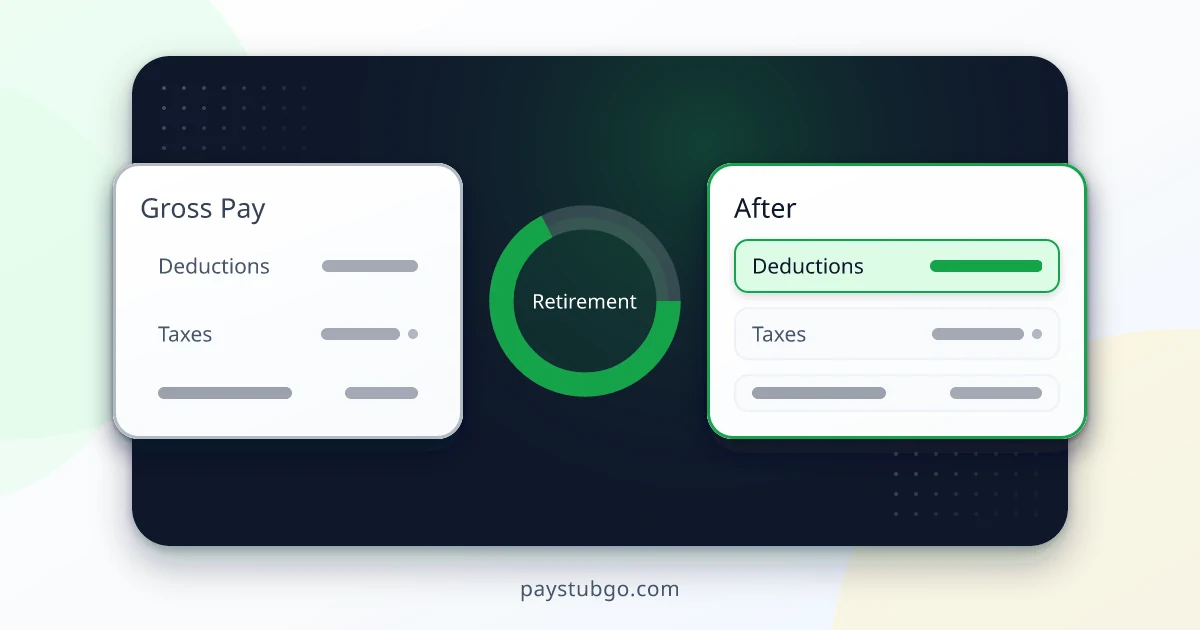
Table of Contents
What this guide covers
9 sectionsHide
Table of Contents
What this guide covers
Scroll inside this box to view all guide topics.
- Deciphering the 401(k) Deduction Line on Your Earnings Record
- The Core Formula: Traditional Pre-Tax Savings vs Roth Post-Tax Deferrals
- Federal Income Tax Withholding Under a Traditional 401(k)
- The Post-Tax Reality of Roth 401(k) Payroll Deductions
- Tracing the Math Across Real Pay Periods
- Handling Employer Matching Contributions on the Statement
- Pennsylvania and Beyond: State Income Tax Exceptions
- Verifying Cumulative Year-to-Date Limits on Your Pay Stub
- How Landlords and Lenders Read Your Retirement Deductions
A traditional 401(k) deduction on a pay stub reduces federal and state taxable income for the current period, lowering immediate tax withholding. A Roth 401(k) deduction is made with post-tax dollars, meaning it does not reduce taxable wages today but provides tax-free withdrawals in retirement. Understanding this accounting flow helps workers verify their take-home pay and keeps payroll records precise.
Elective deferrals under Section 401(k) of the Internal Revenue Code represent one of the most common employee benefit adjustments processed during payroll runs. However, because these plans come in two distinct tax designations—traditional and Roth—they undergo very different journeys through the payroll tax engine. If you are auditing your earnings statement, preparing taxes, or setting up a pay record, knowing exactly how these retirement paths interact with taxable wage bases prevents costly withholding errors.
Deciphering the 401(k) Deduction Line on Your Earnings Record
When you participate in an employer-sponsored retirement plan, your contributions are deducted directly from your earnings each pay cycle. These amounts are listed in the deductions section of your pay statement, usually labeled with terms like "401k," "Ret-T," "401k Roth," or "Ret-R." Although both lines signify money saved for your future, their accounting impact on your current check is completely different.
Every payroll ledger splits deductions into different classifications. A retirement contribution is not just a simple transfer of cash from your gross earnings to a brokerage account. Instead, it acts as a legal adjustment to your taxable compensation. The federal government, state revenue departments, and local tax authorities all establish clear boundaries regarding what constitutes taxable wages.
Because of these boundaries, a single contribution amount can cause your taxable wages to diverge significantly from your gross pay. For employees, reviewing these lines regularly helps make sure that the employer's payroll system is applying tax withholdings to the correct balances. For small businesses, setting up these deductions correctly is critical to avoiding under-withholding penalties during year-end tax reconciliations.
The Core Formula: Traditional Pre-Tax Savings vs Roth Post-Tax Deferrals
The fundamental distinction between a traditional and a Roth 401(k) contribution centers on when the tax liability occurs. A traditional contribution is a pre-tax adjustment, while a Roth contribution is a post-tax adjustment. This choice reshapes the entire taxation layout of your pay stub.
To understand the math, we must first look at how payroll software establishes taxable earnings. When your employer processes your check, they start with your gross pay, which includes regular wages, overtime, bonuses, and commissions. From there, the payroll engine applies pre-tax deductions to determine your taxable wages for different programs.
- Traditional 401(k) Contributions: These are subtracted directly from your gross pay before federal income tax (FIT) and most state income taxes (SIT) are calculated. By reducing your taxable wage base, traditional contributions immediately lower the amount of income tax withheld from your check. However, these funds will be taxed as ordinary income when you withdraw them in retirement.
- Roth 401(k) Contributions: These are made with post-tax dollars. The payroll system does not subtract your Roth contribution from your gross pay when calculating FIT or SIT. The income tax is withheld based on your full taxable wage base, and the Roth contribution is deducted from your remaining net pay. The primary benefit of this path is that your withdrawals in retirement, including any investment growth, are completely tax-free.
For a deeper look at how these general deduction classes interact with other voluntary employer benefit elections, you can review our comprehensive guide on pre-tax vs post-tax deductions on a paystub.
Federal Income Tax Withholding Under a Traditional 401(k)
Federal income tax withholding is calculated using the annualized wage method outlined in IRS Publication 15. When a traditional 401(k) contribution is entered, the payroll system subtracts the contribution from your gross wages before checking the federal tax brackets. This subtraction directly lowers the taxable earnings base for federal income taxes.
For example, if your gross earnings for a biweekly pay period are $2,500 and you contribute 10% ($250) to a traditional 401(k), your federal taxable income for that pay period drops to $2,250. The payroll system then looks up the tax withholding tables for $2,250 rather than $2,500. This immediate drop in taxable income saves you money on withholding in the current pay cycle.
However, it is essential to note that traditional 401(k) contributions do not reduce all taxes. Elective retirement deferrals are subject to Federal Insurance Contributions Act (FICA) taxes, which fund Social Security and Medicare. Under federal tax law, your FICA taxes are calculated on your gross wages before any 401(k) deductions are made. To verify how other benefit categories, such as health insurance or HSA accounts, handle FICA tax calculations, read our guide on paystub deductions explained.
According to official IRS guidelines in IRS Publication 525, elective deferrals to qualified plans are excluded from current-year taxable income for federal income tax purposes but must remain included in wages subject to Social Security and Medicare taxes. This means that a traditional 401(k) deduction on a pay stub will create a permanent difference between your "FIT taxable wages" line and your "FICA taxable wages" line on the same earnings statement.
The Post-Tax Reality of Roth 401(k) Payroll Deductions
When you select a Roth 401(k), the payroll tax calculation follows a completely different order. Because Roth contributions are made post-tax, they provide no immediate relief from federal or state income tax withholding. Your taxes are computed as if the retirement contribution did not exist.
Using the same example of a $2,500 gross paycheck with a $250 Roth contribution, the payroll system calculates your federal income tax withholding on the full $2,500. It also calculates your FICA taxes on the full $2,500. After all taxes are calculated and subtracted from your gross pay to establish your net taxable earnings, the $250 Roth deduction is taken out of your remaining cash.
Because the Roth contribution does not lower your taxable wages, your take-home pay is significantly lower than it would be with a traditional contribution. While this reduces your immediate disposable income, it establishes a pool of retirement assets that can grow and be withdrawn tax-free, provided you meet the qualification criteria set by the IRS.
This post-tax handling means that your FIT taxable wages, state taxable wages, and FICA taxable wages will all remain aligned at the higher gross amount (assuming no other pre-tax deductions exist). To explore how this reduction in current take-home pay shapes your overall cash flow analysis, see our article on gross pay vs net pay on a pay-stub.
Tracing the Math Across Real Pay Periods
To see exactly how these calculations impact an actual paycheck, let us look at three distinct scenarios for the same hourly employee. We will start with a baseline check that has no retirement deductions, and then compare it to checks featuring a traditional 401(k) deduction and a Roth 401(k) deduction.
Illustrative example 1: a single filer in Georgia at $24.00 an hour for 80 regular hours, paid every two weeks, with no pre-tax deductions, one pay period computed with PayStubGo's paystub calculator for the 2026 tax year (an illustration, not tax advice).
| Example 1 line | Amount |
|---|---|
| Regular pay | $1,920.00 |
| Gross pay | $1,920.00 |
| Federal income tax withholding | $146.55 |
| Social Security | $119.04 |
| Medicare | $27.84 |
| Georgia state income tax | $67.02 |
| Net pay | $1,559.55 |
In this baseline scenario, all taxes are calculated on the full gross pay of $1,920.00. The federal taxable wages, state taxable wages, and FICA wages are identical. Now, let us introduce a $150.00 contribution to a Traditional 401(k) plan for the exact same pay period.
Illustrative example 2 (Traditional 401(k) Contribution):
In this scenario, the $150.00 traditional 401(k) contribution is treated as a pre-tax deduction. It is subtracted from the gross pay of $1,920.00 to establish a federal and state taxable income base of $1,770.00. FICA taxes (Social Security and Medicare) are calculated on the full gross pay of $1,920.00, as pre-tax retirement deductions do not reduce FICA obligations.
| Example 2 line | Amount |
|---|---|
| Regular pay | $1,920.00 |
| Gross pay | $1,920.00 |
| Traditional 401(k) deduction (Pre-Tax) | $150.00 |
| FIT Taxable Wages | $1,770.00 |
| Federal income tax withholding | $128.55 |
| Social Security (6.2% of $1,920.00) | $119.04 |
| Medicare (1.45% of $1,920.00) | $27.84 |
| Georgia state income tax | $59.52 |
| Net pay | $1,435.05 |
Because the taxable wage base for federal income tax withholding dropped to $1,770.00, the FIT withholding dropped from $146.55 to $128.55 (saving $18.00 in current federal withholding). Similarly, the Georgia state income tax withholding dropped from $67.02 to $59.52 (saving $7.50 in current state withholding). The total tax savings on this single paycheck is $25.50. This means that while you saved $150.00 for retirement, your net take-home pay only dropped by $124.50 compared to the baseline check.
Now, let us examine the math for the same pay period with a Roth 401(k) contribution of $150.00.
Illustrative example 3 (Roth 401(k) Contribution):
In this scenario, the $150.00 Roth contribution is a post-tax deduction. Taxes are calculated on the full gross pay of $1,920.00. The $150.00 is deducted from your net earnings after all taxes have been withheld.
| Example 3 line | Amount |
|---|---|
| Regular pay | $1,920.00 |
| Gross pay | $1,920.00 |
| FIT Taxable Wages | $1,920.00 |
| Federal income tax withholding | $146.55 |
| Social Security (6.2% of $1,920.00) | $119.04 |
| Medicare (1.45% of $1,920.00) | $27.84 |
| Georgia state income tax | $67.02 |
| Roth 401(k) deduction (Post-Tax) | $150.00 |
| Net pay | $1,409.55 |
In this Roth example, your federal income tax withholding ($146.55) and state tax ($67.02) are identical to the baseline check (Example 1). You receive no current-year tax reduction. The entire $150.00 is deducted directly from your net earnings, resulting in a take-home pay of $1,409.55.
Comparing the two options side by side reveals the immediate cash-flow impact:
- Traditional Net Pay: $1,435.05
- Roth Net Pay: $1,409.55
The difference of $25.50 represents the current tax savings of the pre-tax plan. While the Roth path leaves you with less money in your pocket today, it secures tax-free growth and tax-free withdrawals when you eventually retire, which can offer significant long-term financial benefits.
Handling Employer Matching Contributions on the Statement
Many employer-sponsored 401(k) programs include an employer matching program. If your company matches a portion of your contributions, these matching funds must be documented on your pay statement. However, because these matching funds are paid directly by the employer, they are handled differently from your employee deductions.
An employer matching contribution is a non-taxable benefit in the current year. It is not deducted from your gross pay, nor does it increase your gross pay or tax liability for that pay period. Instead, employer matching contributions are recorded on your pay stub as a "memo" item or under an "Employer Contributions" section.
Under federal IRS regulations, even if you contribute to a Roth 401(k), employer matching contributions have historically been deposited as pre-tax, tax-deferred funds. This means that while your personal Roth contributions grow tax-free, the employer matching portion will still be subject to ordinary income tax upon withdrawal in retirement. Recent tax changes (such as provisions in the SECURE 2.0 Act) allow employers to offer Roth matching contributions, but most standard payroll systems still default to pre-tax employer matching.
Displaying the employer match on the pay stub helps employees confirm that their company is fulfilling its matching agreements each pay cycle. Because these figures are informational, placing them in a separate memo section ensures they do not skew the calculations for gross earnings, tax withholding bases, or net take-home pay.
Pennsylvania and Beyond: State Income Tax Exceptions
While the federal tax treatment of qualified retirement contributions is uniform across the United States, state tax laws can introduce significant variations. When setting up or auditing pay records, you must account for state-specific tax codes that do not conform to federal pre-tax guidelines.
Pennsylvania is a major exception to federal conforming tax rules. Under Pennsylvania Department of Revenue guidelines, employee contributions to traditional 401(k) plans are not exempt from Pennsylvania state personal income tax. Consequently, on a Pennsylvania paystub, employee contributions to a traditional 401(k) are treated as post-tax for state income tax purposes, even though they remain pre-tax for federal income taxes.
This creates a scenario where a worker's FIT taxable wages will be lower than their Pennsylvania SIT taxable wages on the exact same pay stub. For example, if a Pennsylvania worker has $2,000 in gross pay and contributes $200 to a traditional 401(k), their federal taxable income is $1,800, but their Pennsylvania taxable income remains $2,000.
This state-specific variance can lead to significant confusion when using online tools or simple paycheck calculators. This comparison represents typical payroll rules and is not tax or legal advice. For questions regarding your personal retirement contributions or tax liability, consult a qualified CPA or financial professional.
Other states and municipal taxing authorities also maintain unique rules regarding retirement plan deductions and local payroll tax rates. For a deeper look at how local tax systems can alter your earnings statements, read our guide on paycheck calculator vs pay stub and review our state checklist on state-specific paystub details.
Verifying Cumulative Year-to-Date Limits on Your Pay Stub
Your pay stub does more than record the earnings and taxes for a single pay cycle. It also tracks your cumulative financial activity across the calendar year. The year-to-date (YTD) column is a vital tool for monitoring your retirement savings limits and ensuring payroll compliance.
The IRS establishes strict annual limits on the amount of elective deferrals an employee can make to a 401(k) plan. For the 2026 tax year, the basic elective deferral limit is $23,500 (plus an additional catch-up contribution limit of $7,500 for employees aged 50 and over). These limits apply to the combined total of your traditional and Roth contributions.
If you contribute to both types of plans, your pay stub's YTD column allows you to track your progress toward these caps. The payroll system must be configured to automatically stop retirement deductions once you reach the annual IRS contribution limit. Over-contributing to a retirement plan can trigger significant IRS tax penalties and require complex corrective distributions.
If you change jobs mid-year, tracking these limits becomes even more critical. Because your new employer's payroll system only has access to the contributions made under their own plan, they will not automatically account for contributions made at your prior job. You must manually review the YTD totals on your final pay stub from your previous employer to make sure you do not exceed the combined annual limit across both jobs.
How Landlords and Lenders Read Your Retirement Deductions
When you apply for a mortgage, car loan, or apartment rental, verification officers will request your recent pay stubs to evaluate your creditworthiness. When reviewing these records, they look beyond your net take-home pay to assess your overall financial stability.
If a landlord or lender only looked at your net take-home pay, a high retirement contribution rate could make you appear to have less disposable income than you actually do. However, experienced financial reviewers know how to analyze the relationship between your gross pay, tax withholdings, and voluntary deductions.
By clearly identifying traditional and Roth 401(k) deductions on your pay statement, reviewers can see that your lower take-home pay is the result of voluntary long-term savings rather than mandatory debt obligations, garnishees, or lower earning capacity. They can easily add those retirement contributions back into your discretionary income calculation to get an accurate picture of your ability to cover your monthly housing or debt obligations.
Using a clean, structured template with clearly labeled lines prevents any confusion during financial screenings. To create a professional earnings statement with precisely organized pre-tax and post-tax fields, try our online paystub generator or explore our classic and modern layout options on our templates page.
PayStubGo
Create a paystub from your own details
Preview your paystub, review the layout, and download a clean PDF when the information looks right.