Federal overtime rule
Non-exempt employees must be paid at least one and a half times their regular rate for hours worked over 40 in a workweek.
29 U.S.C. §207(a)US Department of Labor, Fair Labor Standards Act
Payroll calendar
This is a plain-English reference page about US holiday and seasonal pay: how a holiday, a seasonal job and year-end withholding appear on a pay stub. It is written for hourly, retail and warehouse workers checking a November or December stub, and for the small employers who issue them.
What federal law does and does not require for holiday work, which dates in the season actually matter, how holiday hours interact with the 40-hour overtime week, and what to check on the last stub of the year.
Last updated
Seasonal offer status
This page is where any PayStubGo seasonal offer is announced, and the status below says plainly whether one is running. Nothing is announced most of the year, and none is promised. The page is a payroll reference first; the status row is here so you never have to guess.
Black Friday, Cyber Monday and the holiday window are retail dates, not PayStubGo events. They are listed so the status beside them is unambiguous.
The Fair Labor Standards Act sets a minimum wage and an overtime rule. It does not require an employer to pay anything extra for work done on a holiday, and it does not require paid time off for a holiday at all. Where holiday pay exists it comes from a company policy, an employment contract or a collective bargaining agreement, and a few states and municipalities add their own rules on top. So two people doing the same work on Thanksgiving can be paid quite differently, and both stubs can be correct.
So the question to ask is not “what am I owed by law” but “what did my employer promise”. Check the handbook or the contract first; if it promises a holiday rate, the stub is where you verify it, and if nothing promises one, its absence is not an error.
Federal holidays bind federal agencies. A private employer is free to observe them, to observe some of them, or to observe none. They still matter to everyone, because banks close and payroll files do not settle on them: a payday that falls on or just after one of these often moves a day earlier.
| Holiday | Observed |
|---|---|
| Veterans Day | Wednesday, November 11 |
| Thanksgiving Day | Thursday, November 26 |
| Christmas Day | Friday, December 25 |
| New Year's Day (following year) | Friday, January 1 |
Scroll the table sideways to see the observed date.
Not federal holidays
These are the dates the season is named after, and the ones most seasonal shifts are scheduled around. They are absent from the federal table above for one reason: they are not federal holidays. Each is computed from the Thanksgiving rule, so it is right in any year.
Black Friday
The day after Thanksgiving
Small Business Saturday
The Saturday after Thanksgiving
Cyber Monday
The Monday after Thanksgiving
Christmas Eve
December 24, the last full retail trading day
Most seasonal retail, delivery and warehouse roles are hired and worked between and . If that is a second job on top of an existing one, the withholding section below is the part to read.
None of these is a federal holiday. Black Friday, Small Business Saturday, Cyber Monday and Christmas Eve carry no federal premium-pay requirement at all: an employer may pay a shift differential or a holiday rate on them, but nothing in the Fair Labor Standards Act obliges it to. Banks and payroll files also settle normally on these days, so a payday is not moved by them the way it is moved by a federal holiday.
Federal overtime is owed on hours actually worked over 40 in a workweek. Paid holiday hours are usually not hours worked, so a week of 36 worked hours plus 8 paid holiday hours is normally 44 paid hours with no federal overtime owed. That surprises people every December, and it is the single most common holiday payroll question.
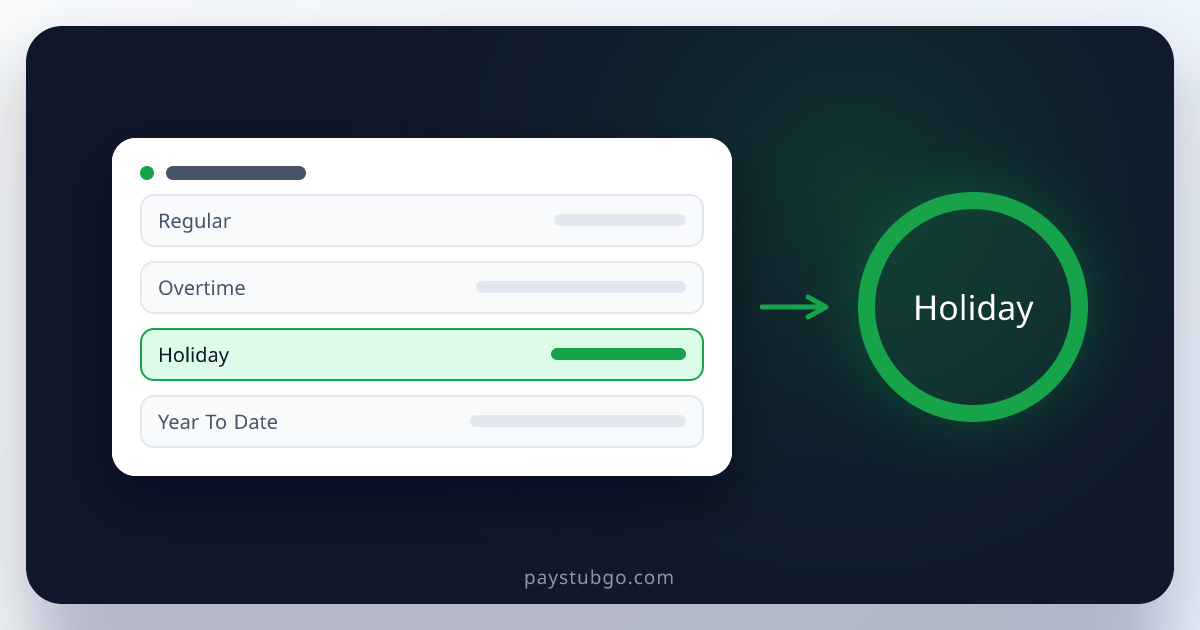
Work that week instead and the arithmetic changes. 44 hours actually worked means 40 at the regular rate and 4 at one and a half times the regular rate, whether or not one of those days was a holiday. Some employers also pay a holiday premium on top by policy; when they do, a well-built stub shows three separate earnings lines — regular, overtime, holiday — rather than folding them together.
The regular rate is not always the hourly rate. Non-discretionary bonuses and shift differentials paid for that week are generally included in it, which nudges the overtime rate up. If a December bonus was promised for hitting a target, that is worth checking on the stub.
A seasonal job is an ordinary job for payroll purposes: the same Form W-4, the same Social Security and Medicare withholding, the same year-end W-2. What changes is that many seasonal workers hold two jobs at once, and each employer withholds as though its wages were the only wages in the year. Two part-year jobs can therefore under-withhold badly, or over-withhold and tie up money until a refund.
Step 2 of Form W-4 exists for this, and the IRS Tax Withholding Estimator is the tool for checking it before the last pay period of the year rather than in April. If you are paid as a contractor rather than an employee, nothing is withheld at all and the December stub will not show any tax lines, which is expected rather than wrong.
The year-to-date column on the final stub of the year is what the W-2 is assembled from. Checking it in December, while payroll can still correct a period, is considerably easier than raising it in February. Four things are worth reading carefully.
And whether it includes the bonus you expected it to include.
The year-to-date figures, against what you expect to owe.
A fixed percentage of covered wages, not a choice anyone makes.
Retirement, health premiums, an HSA — why year-to-date gross and the eventual W-2 Box 1 figure will not match, and that difference is normal.
Each of these is re-checked when this page is updated. The date next to a figure is the date it was verified, not the date it changed.
Non-exempt employees must be paid at least one and a half times their regular rate for hours worked over 40 in a workweek.
29 U.S.C. §207(a)US Department of Labor, Fair Labor Standards Act
$684 per week ($35,568 a year).
operative figure as of September 2026US Department of Labor Fact Sheet 17A
Employers must furnish Form W-2 to employees by January 31 for the prior calendar year.
IRS General Instructions for Forms W-2 and W-3Internal Revenue Service
Holiday payroll FAQs
No. The Fair Labor Standards Act does not require premium pay for work on a holiday or a weekend. Holiday premium pay is a matter of company policy, a contract, or a collective bargaining agreement, and some states and employers go further than federal law does.
No. Black Friday is the day after Thanksgiving and is not a federal holiday, so no federal premium-pay requirement attaches to it. The same is true of Small Business Saturday, Cyber Monday and Christmas Eve. Employers often do pay a differential on those shifts, but that comes from policy, not from law.
Under federal law, overtime is owed on hours actually worked over 40 in a workweek. Paid time off for a holiday is generally not hours worked, so eight paid holiday hours plus 36 worked hours is normally 44 paid hours with no federal overtime. An employer policy or agreement can be more generous, and the stub should show which line is which.
Federal overtime is owed on hours actually worked over 40 in the workweek, so paid holiday hours you did not work are generally left out of that count. Work 44 hours and take eight hours of paid holiday and it is the 44 worked hours that drive it: 40 at the regular rate, four at one and a half times the regular rate, with the holiday hours paid on their own line. An employer policy or agreement can count holiday hours toward the 40, which is more generous than federal law requires, and the stub should show which line is which.
Not in structure. A part-time or short-term seasonal employee gets the same earnings, deduction and year-to-date lines as anyone else, the same Social Security and Medicare withholding, and a Form W-2 by January 31. What changes is scale: fewer hours in a period can make federal income tax withholding look unusually low or high, because each employer withholds as though its wages were the only wages you have in the year. Step 2 of Form W-4 and the IRS Tax Withholding Estimator are what reconcile that across two jobs or a part-year one.
As its own earnings row — commonly "Holiday" or "Holiday Worked" — with its own hours, rate and amount, separate from regular and overtime rows. Keeping it separate is what makes a year-end stub readable against the W-2 later.
Each employer withholds as though its own wages were the only wages. Two jobs in the same period can under-withhold or over-withhold overall. The Step 2 multiple-jobs section of Form W-4 exists for exactly this, and the IRS Tax Withholding Estimator is the tool for checking it before year end.
The year-to-date column: gross, federal and state withholding, Social Security and Medicare, and any pre-tax deductions. Those year-to-date figures are what the W-2 is built from, so a mismatch is far easier to raise with payroll in December than in February.
Helpful related pages
The pay stub glossary
Every abbreviation on the stub, with where it appears.
Build a pay stub
Enter your own figures and see the earnings, deduction and year-to-date lines laid out.
Pricing
What a stub costs, with the first eligible one free.
How to read a pay stub
The same document, read line by line from the top.
Last updated September 18, 2026. General information about US payroll practice, not legal or tax advice. Pay rules depend on facts a wage-and-hour authority or an attorney would assess.